

Well Water Filtration for Bacteria: A 2026 Guide
Table of Contents
- Why Bacteria in Well Water Demands Immediate Treatment
- Well Water Testing for Bacteria: What You Need to Know First
- Well Water Bacteria Treatment Methods: Disinfection vs. Filtration
- UV Water Purifier for Well Water: How UV Disinfection Works
- Whole-House Well Water Filtration Systems: Multi-Stage Protection
- Choosing the Right System: Capacity, Flow Rate, and Maintenance
- Common Mistakes to Avoid When Treating Well Water
- Frequently Asked Questions
Last Updated: October 19, 2026
Why Bacteria in Well Water Demands Immediate Treatment
Bacteria in well water isn't a minor inconvenience, it's a health risk requiring swift action.
Bacteria are invisible, you can't taste, smell, or see them, which is why testing comes first. Not all systems eliminate bacteria equally: some remove sediment but miss microorganisms, others require ongoing chemical treatment.
The most common mistake is installing a system without understanding which contaminants are present, leading to overspending or equipment that doesn't address the real problem.
Well Water Testing for Bacteria: What You Need to Know First
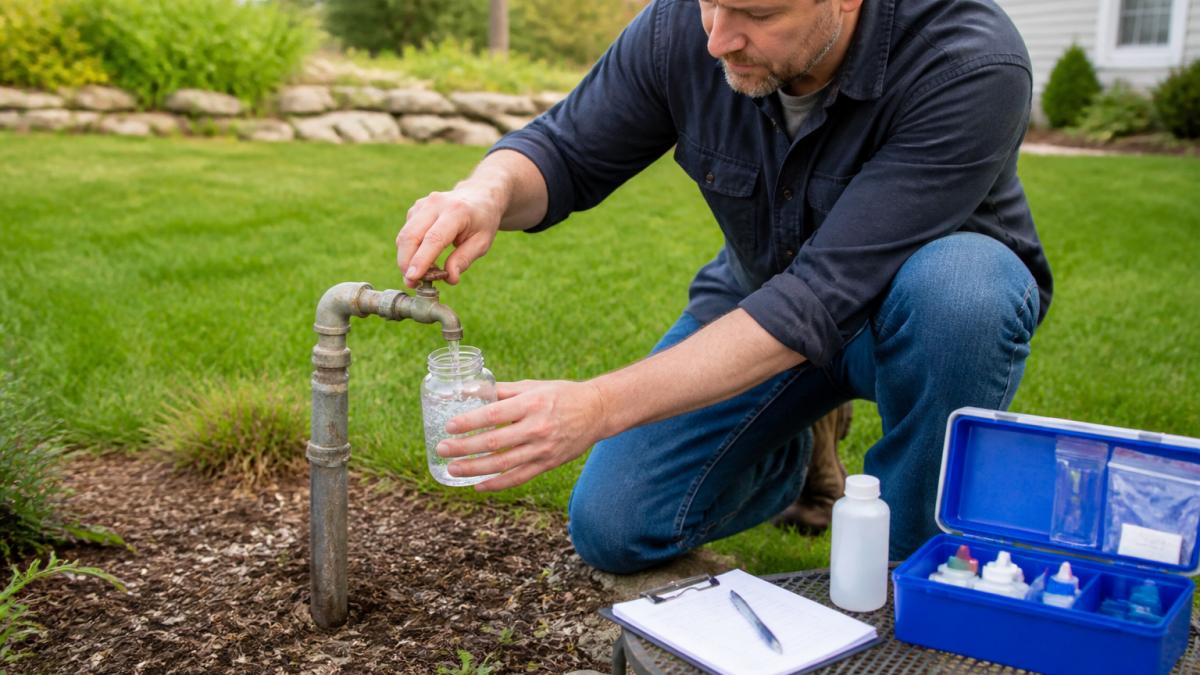
Before investing in any well water filtration system for bacteria, you need a baseline. Testing tells you exactly what you're dealing with and is the only way to verify your treatment works.
Common Bacterial Contaminants in Groundwater
Groundwater naturally contains microorganisms. Most are harmless, but some indicate serious contamination risk. The standard test reports total coliform and, when positive, E. coli, the two results that drive most treatment decisions.
- Total coliform is an indicator group. A positive result means the well or plumbing is vulnerable to contamination. It does not by itself prove fecal contamination, but it always warrants follow-up testing for E. coli and fecal coliform.
- E. coli is a specific fecal indicator and a pathogen. A positive E. coli result is treated as a confirmed contamination event and calls for immediate safe-water precautions, source investigation, and disinfection.
- Iron bacteria and sulfur bacteria are nuisance organisms, not pathogens. They cause slime, staining, and rotten-egg odor. They are managed with oxidation and filtration rather than disinfection alone, and they can foul UV lamps if not pretreated.
Bacteria enter wells through cracks in the casing, a damaged or unsealed well cap, contaminated groundwater nearby, backflow from plumbing, or a failing septic system.
How to Get Your Well Water Tested
The EPA recommends testing your own well annually, and immediately after changes in appearance, taste, or odor, or a suspected contamination event like flooding or a nearby septic failure (the EPA).
A standard bacteria test costs $15-$30 and takes 24-48 hours. The lab tests total coliform and, if positive, E. coli and fecal coliform. If you suspect other contaminants, request a comprehensive panel including iron, manganese, sulfur, nitrate, arsenic, and hardness, those results determine which pretreatment stages you need.
How test results should drive treatment selection
The test result is a treatment specification, not just a pass or fail. Common patterns:
- Total coliform positive, E. coli negative. Investigate the source first: well cap, casing, plumbing, and recent work on the system. Shock chlorination of the well and plumbing is often the first step, followed by retesting. If the problem recurs, a continuous barrier such as UV disinfection after sediment filtration is a reasonable next step.
- E. coli positive. Treat as a confirmed contamination event. Use boiled or bottled water until the system is corrected, shock chlorinate the well and plumbing, retest, and install a continuous barrier. UV is a common choice because it is effective against bacteria, viruses, and protozoa without chemicals.
- Cryptosporidium or Giardia confirmed. Chlorination alone is not reliable for Cryptosporidium. UV disinfection or ultrafiltration is the appropriate barrier, usually after sediment and carbon pretreatment.
Document your results, you'll need them to select the method, size the system, and verify performance. Retest about 30 days after startup, then annually to catch failures early.
Well Water Bacteria Treatment Methods: Disinfection vs. Filtration
Disinfection and filtration are not interchangeable. They work differently, target different organisms, and many wells need both. The table below shows what each method does to bacteria, viruses, and parasites, and where it fails.
| Method | Kills or inactivates bacteria? | Viruses? | Cryptosporidium and Giardia? | Removes the organism from water? | Typical pretreatment needed |
|---|---|---|---|---|---|
| UV disinfection (254 nm) | Yes, with adequate dose and clarity | Yes | Yes (Cryptosporidium is the classic UV success story) | No, DNA is disrupted but cell remains | Sediment filtration to protect the lamp; UVT typically 95% or better |
| Chlorination | Yes, with contact time and residual | Yes, with proper CT | Giardia yes with adequate CT; Cryptosporidium is resistant at normal doses | No | Filtration for turbidity; dechlorination if desired |
| Ozone | Yes, strong oxidant | Yes | Yes, with adequate dose | No | Off-gas handling; often paired with filtration |
| Microfiltration / ultrafiltration | Yes, by physical exclusion (pore size dependent) | Ultrafiltration can; microfiltration generally cannot | Yes, if pore size is small enough | Yes | Pre-filtration; pressure and flow-rate design |
| Reverse osmosis | Yes, by exclusion at the membrane | Yes | Yes | Yes | Sediment and carbon pretreatment; waste-water stream; remineralization often desired |
| Sediment filtration alone | No | No | No | Traps some larger organisms incidentally | None, but it is not a stand-alone bacteria treatment |
The bacteria-specific distinctions that change the recommendation
Not all "bacteria" in a well test mean the same thing; the right method depends on the target organism.
What each method can and cannot do
UV disinfection inactivates bacteria, viruses, and protozoa by disrupting DNA so they cannot reproduce.
Chlorination provides a residual that keeps working in plumbing, which is why public systems rely on it.
Microfiltration and ultrafiltration remove organisms physically rather than killing them.
Reverse osmosis removes bacteria, viruses, parasites, and dissolved contaminants through a semipermeable membrane.
Sediment filtration alone is not a bacteria treatment.
Why the choice depends on what else is in your water
If your well has only bacteria and clear water, UV after a sediment pre-filter is often the simplest continuous barrier. With sediment, iron, or manganese alongside bacteria, you need a multi-stage approach: sediment first, then oxidation and filtration for metals and odor, then UV as the final barrier.
"Disinfection vs. filtration" is a false choice. The right system is a sequence determined by your lab results, not a single product claim.
UV Water Purifier for Well Water: How UV Disinfection Works
UV disinfection is one of the most effective bacteria removal methods for well water, requiring no chemicals and producing no harmful byproducts. The UV Filter MAX from The Water Softener Company destroys 99.99% of bacteria, viruses, and microorganisms including E. coli, Cryptosporidium, and Giardia Lamblia using ultraviolet light.

Why UV Light Destroys Bacteria and Viruses
UV light at 254 nanometers disrupts microbial DNA, rendering organisms unable to reproduce. Bacteria and viruses cannot develop resistance, it's a physical process, not a chemical one.
UV works on all bacteria equally: whether your water contains E. coli, total coliform, or any other microorganism, sufficient contact time and intensity in the UV chamber kills them.
The system operates silently with no salt, chemicals, or ongoing adjustments, and most UV systems connect inline with your main water supply.
UV System Operating Requirements and Limitations
UV disinfection has specific operating conditions: water temperature must stay between 36°F and 104°F, and pressure between 10 and 150 psi. Outside these ranges, UV effectiveness drops.
Water clarity matters, sediment and dissolved minerals reduce UV penetration, so pre-filtration is non-negotiable. The UV Filter MAX requires at least 95% UVT (ultraviolet transmittance); heavily sediment-laden water needs a sediment filter first.
The UV lamp requires annual replacement.
Whole-House Well Water Filtration Systems: Multi-Stage Protection
A multi-stage approach to well water filtration bacteria that addresses multiple contaminants provides the most reliable protection. Whole-house systems treat water at the point of entry, so every tap receives filtered water.
Sediment, Iron, and Odor Removal Before Disinfection
Sediment removal is the foundation: pre-filters trap particles, protecting UV lamps and downstream filters from clogging.
Manganese causes similar staining and requires oxidation. Sulfur creates the rotten-egg odor, which activated carbon removes while improving taste by removing chlorine and organic compounds.
Sequence matters: sediment filtration first, then iron/manganese removal if needed, then carbon filtration, and finally UV disinfection.
NSF Certification and Performance Standards
The UV Filter MAX is designed & manufactured to ASME pressure vessel standards.
Choosing the Right System: Capacity, Flow Rate, and Maintenance
System size must match household water usage, measured in gallons per minute (GPM). The UV Filter MAX delivers 20 GPM at 16mJ/cm² at 95% UVT, or 11 GPM at 30mJ/cm² for higher-intensity disinfection.
A family of four typically uses 300-400 gallons daily. If flow rate can't keep up during peak usage (morning showers, laundry), you'll see pressure drops, undersizing is a common mistake that leads to frustration and system bypass.
Filter Lifespan and Replacement Costs
Sediment pre-filters last 6-12 months depending on load, activated carbon filters 12-18 months, and UV lamps need annual replacement.
Budget for consumables: the UV Filter MAX lamp is designed for a 10,000-hour life (1 year).
Compare that to bottled water: $50 monthly is $600 annually, or $3,000 over five years. A whole-house system pays for itself quickly once you factor in convenience and eliminated plastic waste.
Installation and Support Considerations
Experienced homeowners can DIY, but improper installation can damage the system or create leaks. The Water Softener Company includes installation guidance and customer support.
Fuss-free operation is the goal: the UV Filter MAX includes audible and visual lamp-life indicators so you never run with a dead lamp, and needs minimal maintenance beyond annual lamp replacement.
Common Mistakes to Avoid When Treating Well Water
The biggest mistake is installing a system without testing first.
Neglecting pre-filtration is dangerous. Sediment-laden water reduces UV effectiveness and clogs filters rapidly. Always include sediment removal as the first stage.
Finally, many homeowners skip testing after installation.
Bacteria in well water is treatable with the right approach: testing identifies the problem, and a properly sized, multi-stage system eliminates it.
Frequently Asked Questions
What type of water filtration system removes bacteria from well water?
UV disinfection systems and multi-stage whole-house filtration systems both remove bacteria, but they work differently. UV light kills 99.99% of bacteria, viruses, and microorganisms without chemicals, while physical filtration removes sediment and some microbes through filter media. Many homeowners combine both methods for complete protection. The UV Filter MAX, for example, uses ultraviolet light with an axial-flow design to ensure bacteria cannot hide from the disinfection process, destroying coliform bacteria, E. coli, Cryptosporidium, and Giardia Lamblia.
How do I know if my well water has bacteria before choosing a treatment system?
Contact your local health department or a certified water testing laboratory to have your well water tested for coliform bacteria and E. coli. Testing typically costs $15-$50 and reveals exactly which contaminants are present. This step is critical because treatment methods vary depending on what bacteria you're dealing with. A positive result for coliform bacteria indicates your well may be contaminated at the source or through the plumbing system, and you should disinfect the well before installing a permanent filtration system.
Does a UV water purifier actually kill bacteria in well water, or just reduce it?
UV disinfection kills bacteria, it does not just reduce it. A properly functioning UV system destroys 99.99% of bacteria and viruses through ultraviolet light exposure. However, UV works only on particles in the water passing through at the moment; it does not provide residual protection in your pipes after treatment. This is why many systems combine UV disinfection with pre-filtration stages to remove sediment and iron first, which can block UV light from reaching bacteria.
What is the difference between disinfection and physical filtration for well water bacteria?
Disinfection (UV light or chemicals) kills microorganisms in the water. Physical filtration removes particles and some bacteria through filter media with specific pore sizes. UV disinfection requires clear water to work effectively, so sediment must be removed first. Multi-stage systems handle both: pre-filtration removes sediment and iron, while UV or chemical disinfection destroys bacteria. A whole-house well water filtration system typically uses multiple stages to address different contaminants and ensure safe drinking water throughout your home.