

Water Softener Maintenance Cost Breakdown 2026
Table of Contents
- What a Water Softener Maintenance Cost Breakdown Includes in 2026
- Water Softener Maintenance Checklist: Tasks and What Each One Costs
- Water Softener Salt Cost per Month: What Households Actually Pay
- Water Softener Service Cost: Professional Maintenance and Tune-Ups
- Water Softener Repair Cost: Common Failures and Price Estimates
- DIY vs Professional Service: Where the Money Goes
- Choosing a System That Keeps Maintenance Costs Down
- Frequently Asked Questions
Last Updated: October 16, 2026
What a Water Softener Maintenance Cost Breakdown Includes in 2026
A water softener maintenance cost breakdown is the itemized list of everything you'll spend to keep a softening system running: salt, service calls, replacement parts, and the water and electricity it uses along the way.
Here's the honest math: the purchase price is only part of the story. The EPA's guidance on water efficiency notes that water-efficient appliances cut both utility use and long-run costs, and softeners work the same way.
Water Softener Maintenance Checklist: Tasks and What Each One Costs
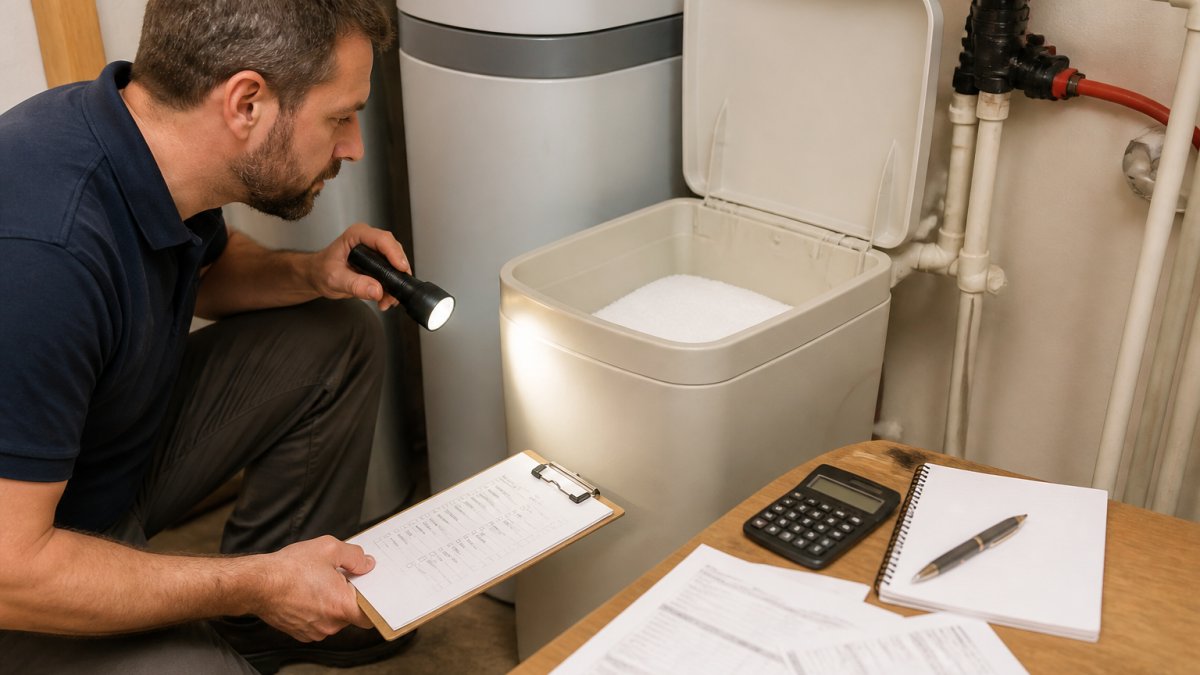
A water softener maintenance checklist is a simple schedule of recurring tasks that keep your system softening water instead of quietly failing. Most tasks take minutes. A few need a pro. Here's what each one typically involves.
Monthly and Quarterly Tasks
- Check the salt level: Top up when it drops below half. Cost: the salt itself.
- Look for salt bridges: A crusty layer traps salt and stops regeneration. Break it up with a broom handle.
- Inspect for leaks: A quick look at fittings and the brine line.
Annual Tasks and Replacement Parts
- Clean the brine tank: Flush out sediment once a year.
- Replace the resin: Every 10-15 years, depending on water quality.
- Service the valve: A pro check keeps regeneration on track.
Water Softener Salt Cost per Month: What Households Actually Pay
Water softener salt cost per month is the single most predictable ongoing expense, and it scales with household size, water hardness, and how the system is programmed to regenerate. A small household on moderately hard water spends far less than a large family on very hard well water. Salt consumption is driven by how often the system regenerates, which depends on how much water you use and how hard that water is.
The 2026 numbers behind the estimate
Here is the math, stated plainly so you can swap in your own figures:
- Salt price: Plain solar salt pellets and crystals commonly run about $6 to $10 per 40-lb bag at hardware and big-box stores in 2026. Potassium chloride pellets, a chloride-free alternative for households concerned about sodium or discharge, typically run two to three times that, roughly $20 to $30 per 40-lb bag.
- Salt per regeneration: A typical softener uses about 6 to 12 lb of salt per regeneration cycle, depending on capacity setting and hardness. High-efficiency units that meter actual usage often land at the low end.
- Regenerations per month: A 1-2 person household on moderately hard water commonly regenerates 4 to 6 times a month; a 3-4 person household 6 to 10 times; a 5+ person household on very hard well water 10 to 15 times.
- Monthly salt cost: Multiply bags by price. At $8 per 40-lb bag, a household burning one bag a month spends about $8; a heavy-use well-water household burning two to three bags spends roughly $16 to $24.
Salt cost by household profile
| Household Size | Water Use | Typical Regenerations/Month | Salt per Month | Estimated Monthly Salt Cost |
|---|---|---|---|---|
| 1-2 people | Low | 4-6 | ~20-30 lb | $4-$8 |
| 3-4 people | Medium | 6-10 | ~40-60 lb | $8-$14 |
| 5+ people | High | 10-15 | ~60-90 lb | $12-$20 |
These are salt-only figures. They exclude the water and electricity each regeneration consumes, which are covered in the lifetime-cost section below.
What actually moves your salt bill
- Hardness level. Going from 7 grains per gallon to 20 grains per gallon can roughly double the salt needed per regeneration.
- Regeneration trigger. Timer-based systems regenerate on a fixed schedule whether you used water or not. Metered, demand-initiated systems regenerate only when resin is exhausted, which is where most of the savings come from.
- Salt type. Rock salt is cheapest but leaves more insoluble residue and requires more brine tank cleaning. Pellets are the common middle ground. Potassium chloride costs more but avoids sodium in the softened water.
- Bridging and mushing. Salt that crusts over or turns to sludge stops dissolving, so you buy more salt while the system under-softens. Breaking bridges and not overfilling the tank keeps consumption honest.
The efficiency lever
A high-efficiency system cuts salt use by regenerating against actual usage rather than a fixed clock. Our Soft Water System uses up to 60% less salt and 60% less water than older softeners, thanks to precision brine regeneration that adjusts to real demand. On a household spending $15 a month on salt, that difference can contribute to more consistent monthly costs.

| Household Size | Water Use | Salt Frequency | Best System Fit |
|---|---|---|---|
| 1-2 people | Low | Every 6-8 weeks | Model 1000 (1-4 baths) |
| 3-4 people | Medium | Every 4-6 weeks | Model 2000 (4-6 baths) |
| 5+ people | High | Every 3-4 weeks | Model 3000 (6-8 baths) |
Water Softener Service Cost: Professional Maintenance and Tune-Ups
Water softener service cost covers the annual tune-up and any professional adjustments your system needs. Many homeowners skip this and may face premature repairs. A yearly service visit checks the valve, tests hardness, and confirms regeneration is dialed in.
What a service visit actually costs in 2026
Plumbing and water-treatment labor in the U.S. commonly runs $75 to $150 per hour, with a typical service-call minimum of $100 to $200 that covers the first hour or the trip charge. Against that backdrop:
- Annual tune-up (no parts): Most homeowners pay roughly $100 to $250 for a single visit that includes a hardness test, valve inspection, brine system check, and regeneration cycle verification.
- Diagnostic-only visit: $75 to $150 if you just want a technician to identify the problem before you decide on repair.
- Service contract / maintenance plan: $150 to $400 per year. These bundle the annual visit with priority scheduling. They can be beneficial if you are on well water or have a complex multi-stage system; they may not be as cost-effective for a simple municipal-water softener.
- After-hours or emergency call: Add $75 to $200 to any of the above.
What the technician should actually do
A legitimate tune-up is not a visual glance. Ask for these steps, and confirm them on the invoice:

- Test hardness at the tap, not just at the tank.
- Verify the regeneration cycle runs end to end and the brine draw is pulling properly.
- Inspect the control valve, piston, and seals for wear.
- Check the brine line for clogs and the brine tank for bridging or mushing.
- Confirm the hardness and capacity settings match your current water.
- Check for leaks at fittings, bypass valve, and drain line.
When to skip the contract
You do not need a service contract to keep costs down. A common mistake is paying for monthly or quarterly "maintenance plans" that do little beyond a visual check. Instead, budget for one annual visit and handle the simple tasks yourself. If you are on well water, mineral concentration runs higher, so a pro check matters more.
DIY vs pro: the same tasks, priced both ways
| Task | DIY Cost | Pro Cost | Recommendation |
|---|---|---|---|
| Hardness test | $10-$20 (strips) | Included in visit | DIY |
| Brine tank clean-out | $0-$15 (brush, bucket) | $100-$200 | DIY |
| Salt bridge break-up | $0 | $100-$150 | DIY |
| Brine line flush | $0-$10 | $100-$200 | DIY if accessible |
| Control valve service | Parts only, $50-$200 | $200-$450 with labor | Pro |
| Resin replacement | $200-$500 (resin) | $400-$900 installed | Pro |
Regional variation and how to adapt these numbers
Labor rates vary widely by metro. High-cost coastal metros can run 30-50% above the ranges above; rural areas can run 20-30% below. When you get a quote, ask for the hourly rate, the trip charge, and whether parts are marked up. Those three numbers explain most of the spread between bids.
Water Softener Repair Cost: Common Failures and Price Estimates
Water softener repair cost depends on which part fails. Most repairs fall into a handful of predictable categories, and knowing the symptoms helps you avoid an expensive emergency call.
- Salt bridge or mushing: Often a DIY fix, no parts needed.
- Faulty control valve: The most common pro repair. Needs a technician.
- Clogged brine line: Usually a quick clean-out.
- Failed resin: Rare, and typically a replacement decision rather than a repair.
If a repair estimate climbs toward the price of a new high-efficiency unit, replacement can be a consideration. New systems can help reduce salt and water use, which may contribute to long-term savings.
DIY vs Professional Service: Where the Money Goes
DIY versus professional service comes down to two questions: is it safe, and is it worth your time? Salt checks, brine tank cleaning, and hardness testing are all easy DIY tasks. Valve work, resin replacement, and anything involving the main water line belong to a pro.
| Task | DIY or Pro | Why |
|---|---|---|
| Salt refill | DIY | Simple, no tools |
| Brine tank cleaning | DIY | Annual, low risk |
| Hardness testing | DIY | Strips included with our systems |
| Valve repair | Pro | Needs parts and know-how |
| Resin replacement | Pro | Full tank service |
The rule we give customers: if it touches the plumbing or the electronics, call a pro. Everything else, save the money.
Choosing a System That Keeps Maintenance Costs Down
The best way to lower maintenance costs is to pick a system built for low upkeep. Our Soft Water System is designed around one idea: just add salt.
For well water, our Lifeguard Well Water Filter & Softener handles iron, sulfur, and hardness in one setup, which can simplify maintenance compared to stacking separate units. Every system ships free to the contiguous 48 states.

Frequently Asked Questions
How much does it cost to maintain a water softener per year?
Annual water softener maintenance cost typically runs $150 to $400 for salt-based systems. That includes salt refills at $10 to $20 per 40-pound bag, plus occasional resin cleaner and a professional tune-up every 12 to 18 months. Households with high water usage or hard water above 15 grains per gallon may spend closer to the top of that range because the system regenerates more often and burns through salt faster.
How much does water softener salt cost per month?
Water softener salt cost per month averages $10 to $30 for a family of four. A single person using less water might spend $5 to $10 monthly, while a large household with hard water can hit $40. Salt consumption depends on water hardness, household size, and how often the system regenerates. High-efficiency models use up to 60% less salt than older softeners, which lowers this line item considerably over a year.
Can I maintain a water softener myself?
Most routine water softener maintenance is DIY-friendly. Adding salt, checking the brine tank for salt bridges, cleaning the venturi, and testing hardness take about 15 minutes a month. A water softener maintenance checklist for these tasks costs nothing beyond salt and test strips. Reserve professional service for valve issues, resin problems, or electrical faults, since those repairs require diagnostic tools and parts that homeowners rarely have on hand.
What are the signs that a water softener needs servicing?
Watch for hard water spots returning on dishes, soap that will not lather, salty-tasting water, or the system running through salt unusually fast. A brine tank that stays full, error codes on the control head, or water pressure drops also signal trouble. Addressing these early keeps water softener repair cost low, since a $150 to $300 service call is far cheaper than a $500 to $900 valve or resin replacement down the road.
Maintenance costs are predictable once you know the moving parts, but the system you start with decides how high they climb. At The Water Softener Company, we build high-efficiency systems that cut salt and water use, adjust automatically to your household, and come with a five-year warranty and free shipping. Get started with The Water Softener Company and keep your maintenance costs low for the life of your system.