

How to Size a High Capacity Water Softener for Large Households in 2026
Last Updated: November 22, 2026
Quick Summary
Size a high capacity water softener by multiplying people by daily gallons and hardness in GPG, then by 7 days between regenerations, and adding a 20 to 30 percent reserve. Then check peak flow in GPM and take the larger of the grain-capacity and flow-rate recommendations.
- A family of five at 18 GPG lands on a 64,000-grain unit after adding a 25 percent reserve.
- Each additional person adds roughly 750 to 1,500 grains of daily demand, depending on hardness.
- The WQA recommends removing about 4,000 grains of hardness per pound of salt for efficient salt use.
- The Model 2000 offers 64,000 grains and 18 GPM for four-to-six-bathroom homes, starting at $1,699.
- Use bathroom count for flow rate and household size for grain capacity, then take the larger recommendation.
Table of Contents
- Why Large Households Outgrow Standard Water Softeners
- Water Softener Grain Capacity: The Number That Decides Everything
- Using a Water Softener Size Calculator for Your Home
- What Size Water Softener for a Family of 4 (and How to Scale Up)
- Water Softener Regeneration Frequency and Efficiency Settings
- Peak Flow Rate and Service-Flow Capacity: The Spec Most Buyers Skip
- Matching a High Capacity Water Softener to Your Bathroom Count
- Choosing Your High Capacity Water Softener Model
- Frequently Asked Questions
Why Large Households Outgrow Standard Water Softeners
A high capacity water softener for large households solves a problem that smaller units cannot: the math of daily demand.
A softener sized for a smaller household can work fine until the family grows or a water test comes back harder than expected.
The fix is not simply buying the biggest tank on the market.
Water Softener Grain Capacity: The Number That Decides Everything
Grain capacity is the total amount of hardness minerals a softener's resin can remove before it must regenerate, measured in grains. A 64,000-grain unit removes 64,000 grains of hardness between regeneration cycles.
That number is the ceiling, not the daily rating. Manufacturers publish a "peak" capacity under ideal lab conditions, and real-world capacity runs lower once you account for salt dose and resin age.
For a large household, grain capacity should be calculated from actual demand, not guessed from a chart. If you want the full sizing method behind that number, our guide on how to choose water softener size for your home walks through every step.
Using a Water Softener Size Calculator for Your Home
A water softener size calculator takes three inputs and returns a recommended capacity in grains. The formula is simple enough to run on paper, but most charts are too coarse for a large household. Below is a worksheet you can reproduce with your own numbers, plus the two corrections, reserve capacity and peak flow, that separate a unit that keeps up from one that runs dry by mid-morning.
Daily hardness removal = people × gallons per person per day × hardness in GPG
Then multiply by the number of days you want between regenerations. Seven days is a common target for a large household because it keeps the resin from sitting exhausted and lets you regenerate on a predictable schedule.
Large-Household Sizing Worksheet
Work through these five steps in order. Keep every number in the same units, gallons per day and grains per gallon (GPG).
- Count occupants, including regular guests. Use the number of people sleeping in the house most nights, then add one for a frequent guest or live-in relative. A household that swings between four and seven should size for seven.
- Estimate daily gallons. A common planning figure is 75 gallons per person per day for indoor use; large homes with heavy laundry often run 85 to 100. Multiply occupants by your gallons-per-person figure.
- Enter hardness in GPG. Use a lab test or calibrated test strip. If your report gives hardness in mg/L (same as ppm), divide by 17.1 to convert to GPG.
- Multiply gallons by GPG to get daily grains removed.
- Multiply by days between regenerations (typically 7) and add a 20 to 30 percent reserve for guests, heavy laundry days, and resin aging. Round up to the nearest standard capacity: 24,000, 32,000, 40,000, 48,000, 64,000, or 80,000-plus grains.
Worked Example: Family of Five at 18 GPG
- 5 people × 75 gallons per day = 375 gallons daily
- 375 gallons × 18 GPG = 6,750 grains removed per day
- 6,750 × 7 days = 47,250 grains per week
That household lands on a 64,000-grain unit, not the 48,000 a bare-minimum calculation suggests. The reserve covers the weekend when three loads of laundry run and the in-laws stay over.
Worked Example: Family of Six at 25 GPG
- 6 people × 85 gallons per day = 510 gallons daily
- 510 gallons × 25 GPG = 12,750 grains removed per day
- 12,750 × 7 days = 89,250 grains per week
At that demand, a single 64,000-grain tank regenerates roughly every four to five days, which is workable but tight. This is where a twin-tank configuration starts to make sense, because one tank can soften while the other regenerates.
The Two Corrections Most Calculators Skip
Reserve capacity. A unit sized exactly to weekly demand has no margin for the variability real households produce. That is why the worksheet adds a reserve rather than rounding down.
Peak flow. Grain capacity says nothing about whether the unit can supply two showers, a dishwasher, and a washing machine at once. Check the service-flow rating in gallons per minute (GPM) against your fixture load, then take the larger of the grain-capacity and flow-rate recommendations.
Test Before You Size
Hardness varies by source and season. Municipal supplies can shift when a utility blends sources, and well water often swings between wet and dry seasons. Test raw water at a bypass tap, not softened water, and if you are on a well, test for iron and manganese at the same time, iron consumes resin capacity and can foul an otherwise correctly sized softener.
If you want the full sizing method behind these numbers, our guide on how to choose water softener size for your home walks through every step.
What Size Water Softener for a Family of 4 (and How to Scale Up)
What size water softener for a family of 4 usually lands at 32,000 to 40,000 grains, assuming moderate hardness near 10 GPG and average water use. Bump to 48,000 if hardness runs above 15 GPG or the household does heavy laundry.
Scaling up follows the same logic, one variable at a time:
- Add people: each additional person adds roughly 750 to 1,500 grains of daily demand, depending on hardness.
- Add bathrooms: more fixtures mean higher peak flow, a separate spec covered below.
- Add hardness: double the GPG and you roughly double the required capacity.
The mistake we see most often is buying for today's family and ignoring the next five years. A 40,000-grain unit that fits four people comfortably becomes marginal at six. Size for the household you expect, not just the one you have.
Water Softener Regeneration Frequency and Efficiency Settings
Water softener regeneration frequency should be set so the system regenerates before the resin is exhausted, typically every 7 to 14 days for a correctly sized unit. Demand-initiated regeneration, which triggers based on actual gallons used rather than a fixed calendar, is one efficient option. For a large household, the settings that determine salt use, water waste, and operating cost are the salt dose and the regeneration water volume.
Advertised Capacity vs. Usable Capacity
A 64,000-grain unit does not deliver 64,000 grains between every regeneration. Manufacturers publish a peak capacity measured under ideal lab conditions with a high salt dose. In service, usable capacity depends on how much salt you dose per regeneration and how old the resin is. A unit run at a low salt dose delivers 60 to 75 percent of its rated capacity, while the same unit at a high dose approaches the rating but wastes salt.
Salt Dose and the Grains-per-Pound Trade-off
The Water Quality Association's best practices guidance recommends sizing so the system removes roughly 4,000 grains of hardness per pound of salt, which keeps salt use efficient instead of brute-forcing regeneration. That figure is a target, not a law. Lower doses per regeneration use less salt but regenerate more often and can leave capacity on the table; higher doses recover more capacity per cycle but push salt efficiency down.
Regeneration Water Use
The WQA recommends no more than 5 gallons of water per 1,000 grains during regeneration. A 64,000-grain unit regenerating at that rate uses about 320 gallons per cycle, roughly 16,600 gallons a year at weekly regeneration. A unit that ignores the guideline can waste thousands of gallons more per year, and on a metered municipal supply that shows up on the bill.
Comparing Settings Side by Side
Rather than treating advertised grain capacity as the only measure, compare configurations on four numbers: usable capacity per regeneration, pounds of salt per regeneration, gallons of water per regeneration, and regenerations per year. A unit that regenerates every five days at a low salt dose and one that regenerates every ten days at a higher dose can deliver similar softening while differing meaningfully in annual salt and water use. Ask for the salt and water figures at the dose you intend to run.
When Demand-Initiated Regeneration Matters Most
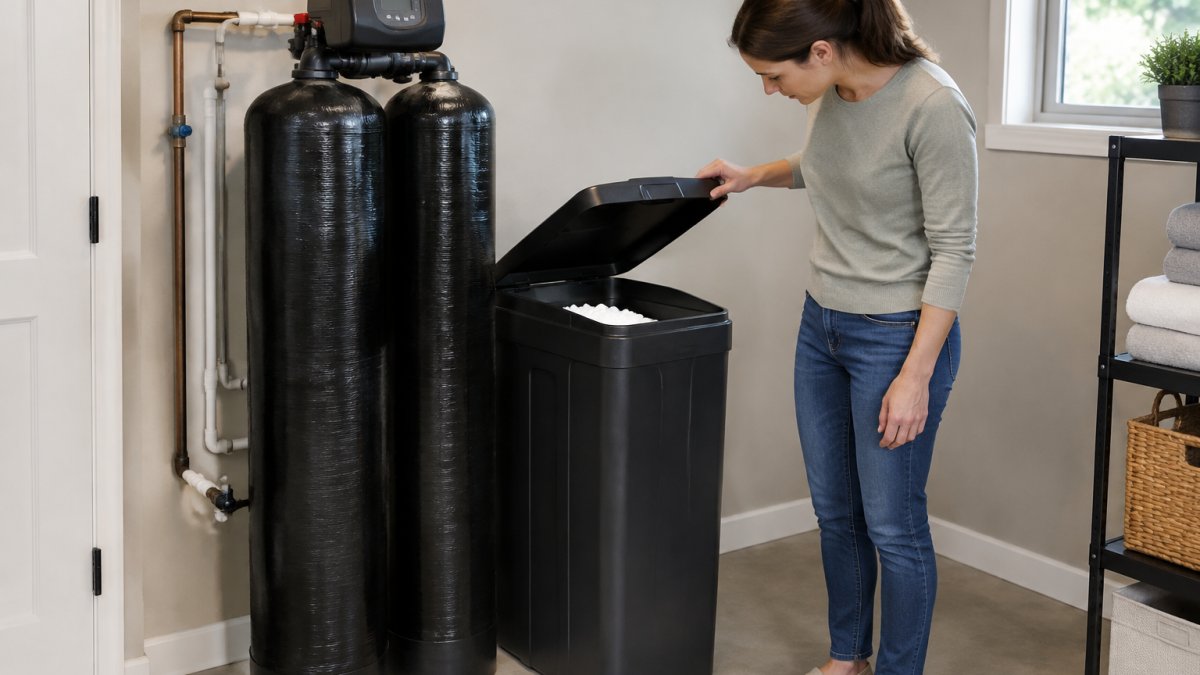
A large household's demand is not flat. Weekends, holidays, and guests push gallons up; quiet weeks pull them down. A calendar-based timer regenerates on schedule regardless, wasting salt and water in light weeks and risking exhaustion in heavy ones. Demand-initiated control measures actual gallons and regenerates when the resin needs it. Pair it with a salt-level sensor so you are not guessing when the brine tank needs refilling.
Twin-Tank and Two-Tank Configurations
A single-tank unit cannot soften while it regenerates, so during a cycle the house gets hard water or bypasses the softener entirely. For a large household with high continuous demand, or one where the softener is sized close to its limit, a twin-tank system keeps soft water available around the clock because one tank softens while the other regenerates.
Operating Cost, Not Just Purchase Price
Salt and regeneration water are the recurring costs, and they scale with how often the unit regenerates and how much salt each cycle uses.
Watch out: lowering the salt dose to save money without checking usable capacity can leave the resin exhausted before the next regeneration, verify the grains-per-pound figure at your chosen dose before you cut it.
The Water Quality Research Foundation's softened water study examined how softened water affects household water-heater efficiency, and efficiency gains depend on the softener running correctly, not just existing. If you want to understand the cycle itself, our article on what happens during a water softener regeneration cycle explains each stage and how to time it around heavy water use.
Peak Flow Rate and Service-Flow Capacity: The Spec Most Buyers Skip
Service flow rate is the gallons-per-minute a softener can treat while water is running, and it is the spec large households ignore at their peril.
Flow rate is measured in GPM and tied to tank and valve size. Here is how our models line up:
| Model | Bathrooms | Flow Rate | Grain Capacity |
|---|---|---|---|
| Model 1000 | 1-4 | 12 GPM | 34,000 |
| Model 2000 | 4-6 | 18 GPM | 64,000 |
| Model 3000 | 6-8 | 22 GPM | 86,000 |
Bathrooms
A family of six with three bathrooms running morning routines simultaneously needs the 18 GPM tier, even if the grain math alone would suggest a smaller unit. If pressure is already a concern in your home, our article on whether water softening improves water pressure addresses that directly.
Matching a High Capacity Water Softener to Your Bathroom Count
Bathroom count is the fastest proxy for peak demand, and it is how we organize our own sizing. One to four bathrooms fits the Model 1000 at 34,000 grains and 12 GPM.
Bathroom count captures fixture load, but it misses occupancy. A six-bathroom house with two residents needs less capacity than a four-bathroom house with seven.
Choosing Your High Capacity Water Softener Model
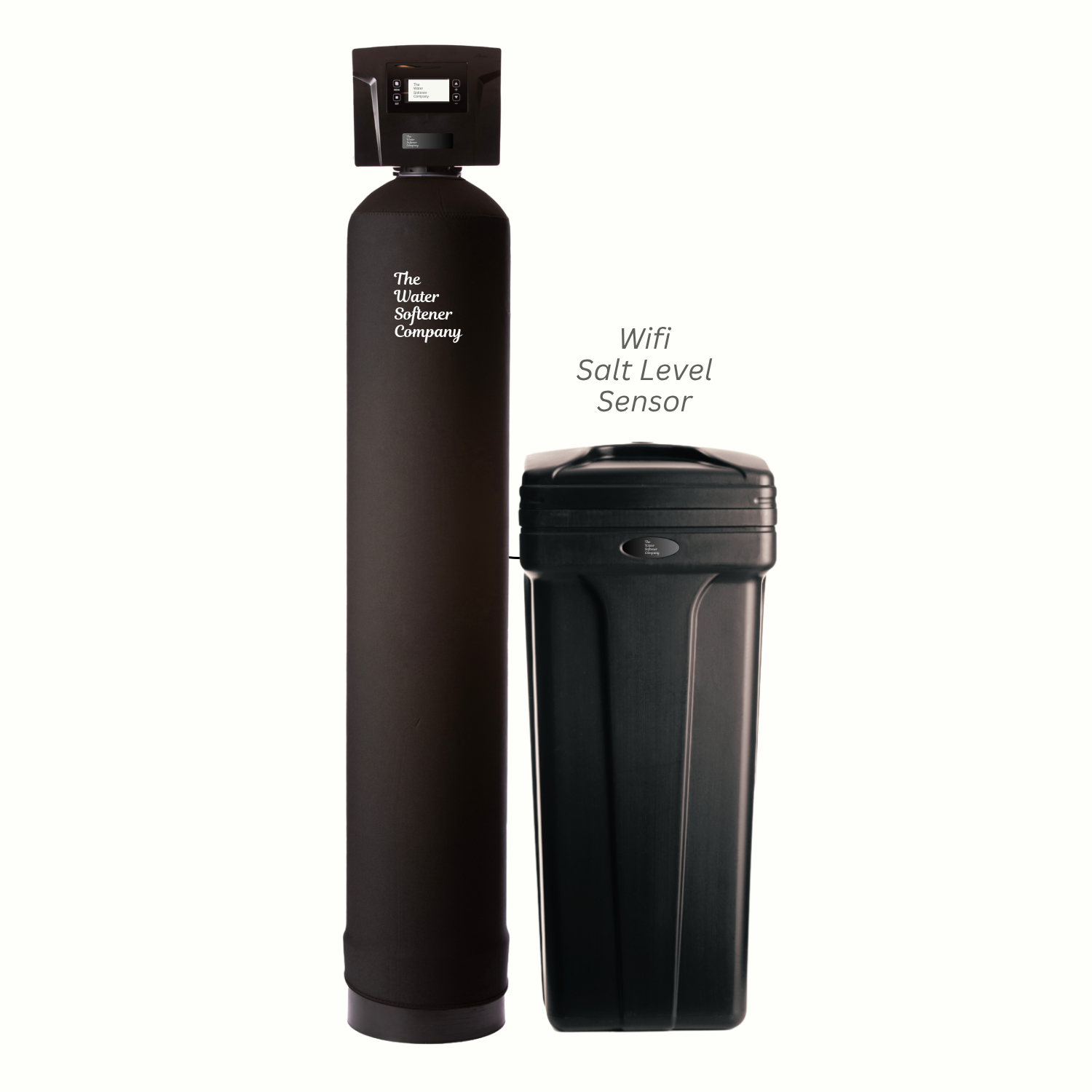
Our Soft Water System covers most large families. It ships with a hardness tester, a WiFi salt-level sensor, and a five-year full system warranty, and it is available here starting at $1,699.
If your water also carries chlorine, odors, or low-level iron, the Carbon Softener System adds coconut carbon and KDF filtration to the same softening platform for $2,199. Compare the full lineup on our soft water system page or the carbon softener system page.
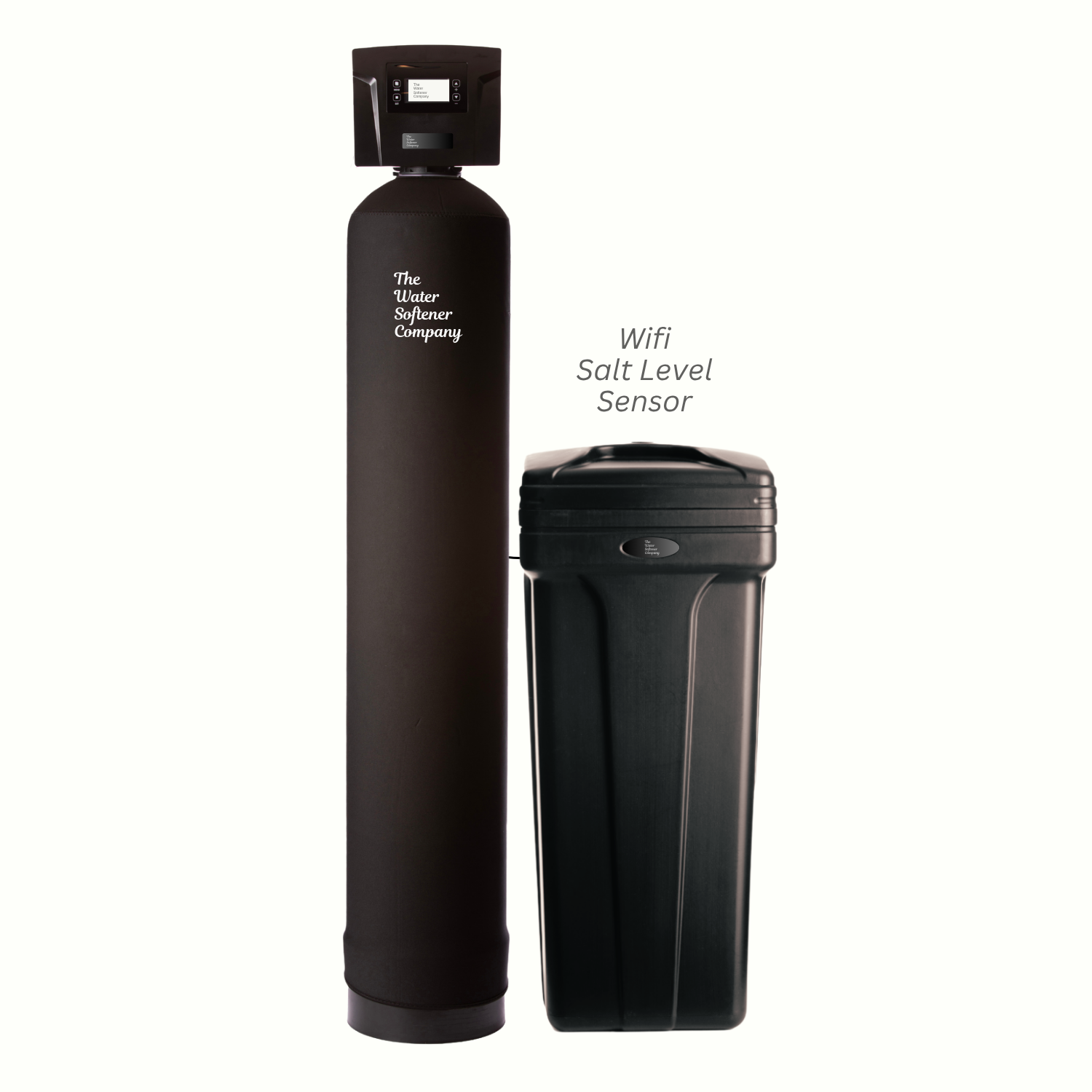
Best for: homes with four or more bathrooms and five-plus residents. Skip if: you have one or two bathrooms and moderate hardness, where a smaller unit saves money without sacrificing performance.
Sizing a high capacity water softener for a large household is a calculation, not a guess, and getting it wrong costs you salt, water, and appliance life.
Frequently Asked Questions
What size water softener do I need for a large household?
Start with daily water use. Multiply the number of people by roughly 75 to 100 gallons per day, then multiply by your water hardness in grains per gallon (GPG). A family of six at 15 GPG and 90 gallons per person uses about 8,100 grains daily, or 56,700 per week. Size the unit so it regenerates about once a week without running short, which points most large households to a 64,000-grain model or higher. Test your water first so the hardness figure is real, not guessed.
How does water hardness affect water softener sizing?
Hardness is the multiplier in every sizing calculation. At 5 GPG, a household removes far fewer grains per day than the same household at 25 GPG. Well water often runs harder than municipal supply and can change with the season, so test it more than once. If your hardness reads 20 GPG or above, add capacity headroom or plan to regenerate more often. A unit that fits a 10 GPG home can be undersized for the same family at 25 GPG.
How often should a high capacity water softener regenerate?
Most high capacity units are set to regenerate about once a week, though demand-initiated systems adjust based on actual usage. If your system regenerates every night, it is likely undersized or set too conservatively. If it stretches past ten days, you may be carrying more capacity than you need.
Is a larger water softener always better for a big family?
No. Oversizing can waste salt and water because the resin sits idle between long regeneration cycles. Undersizing is worse: you run out of soft water mid-week and the resin works harder than it should. Match grain capacity to your calculated daily removal, check the service flow rate against your peak demand, and pick a model with demand-initiated regeneration so the system adjusts as your household's usage shifts.
