

What Happens During a Water Softener Regeneration Cycle?
Last Updated: November 8, 2026
Quick Summary
Water softener regeneration is the process that recharges a softener's resin bed so it can keep removing hardness minerals from your water. A salt brine washes calcium and magnesium off the resin beads, restoring their sodium coating. The full cycle follows five stages: Fill, Brining, Brine Rinse, Backwash, and Fast Rinse.
- A full regeneration cycle typically takes 60 to 120 minutes, depending on your system and settings.
- Brining is the longest stage and the one that actually restores softening capacity.
- Schedule regeneration between 2 a.m. and 4 a.m., when your household uses little or no water.
- Skip timer-based settings if your unit supports metering, since timed cycles waste salt and water.
- Water at your taps runs hard during the cycle, then turns soft once it finishes.
Table of Contents
- What Water Softener Regeneration Actually Does
-
The Water Softener Regeneration Process Step by Step
- Stage 1: Fill, Water Enters the Brine Tank
- Stage 2: Brining (Brine Draw), Brine Travels Down Through the Resin
- Stage 3: Brine Rinse, Clearing Residual Salt Water
- Stage 4: Backwash, Reversing Flow to Flush the Bed
- Stage 5: Fast Rinse, Final Flush Before Service Resumes
- What Happens at Your Taps During Each Stage
- Water Softener Manual Regeneration Cycle Time: What to Expect
- How to Set Water Softener Regeneration Time
- Water Softener Regeneration Noise: Normal Sounds vs. Warning Signs
- When Regeneration Runs Too Long, Too Often, or Stalls
- Sizing a System So Regeneration Fits Your Household
- Frequently Asked Questions
What Water Softener Regeneration Actually Does
Water softener regeneration is the process that recharges a softener's resin bed so it can keep removing hardness minerals from your water. Most new softeners run this cycle automatically, based on how much water your household actually uses, according to the University of Minnesota Water Resources Center's residential softening guide.
Here is the short version. Hard water carries calcium and magnesium. The resin beads grab those minerals and hold them. Once the beads are full, a salt brine washes them clean. That is regeneration in one sentence.
Why the Resin Bed Runs Out of Capacity
Every resin bed has a limit. It can only hold so many hardness ions before it stops softening.
As water passes through, calcium and magnesium collect on the beads. The beads slowly fill up. This is called resin exhaustion. A softener with a 34,000-grain capacity, like our Model 1000, holds more minerals than a smaller unit, so it regenerates less often.
Watch for the signs of a full bed:
- Slick or filmy feeling on your hands
- White spots returning on glassware
- Soap that will not lather well
When those signs show up, the resin needs a recharge.
How Ion Exchange Swaps Hardness Ions for Sodium
Ion exchange is the chemical swap at the heart of every softener. Hardness ions in your water trade places with sodium ions held on the resin beads.
Here is how it works:
- Hard water flows into the resin tank
- Calcium and magnesium stick to the beads
- Sodium ions release into your water
- Soft water flows out to your taps
The beads never wear out. They just need that sodium coating restored. That is what the brine does during regeneration.
EXTERNAL_LINK: Soft Water System
The Water Softener Regeneration Process Step by Step
The water softener regeneration process step by step follows five stages: Fill, Brining, Brine Rinse, Backwash, and Fast Rinse. The whole cycle usually runs at a time you set, often overnight. Here is the flow through the valve and tanks at each stage.
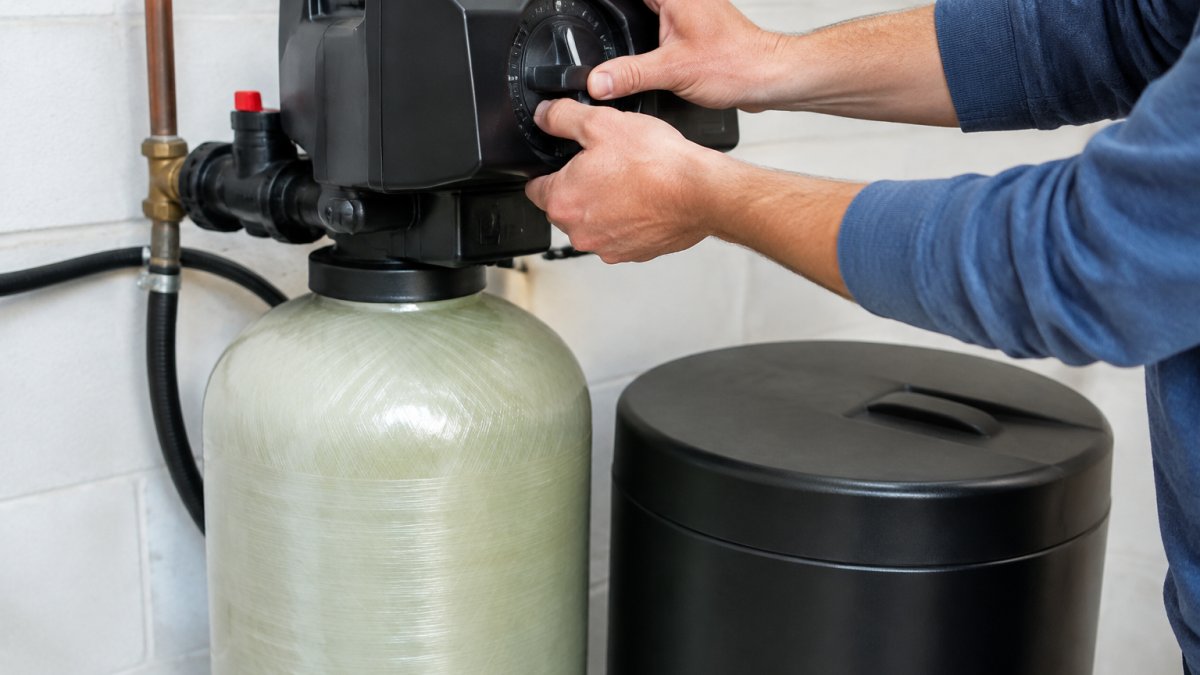
Stage 1: Fill, Water Enters the Brine Tank
The control valve closes the service inlet and opens a path from the household water supply to the brine tank. A measured volume of water enters the salt tank and dissolves salt to create brine. The resin tank is isolated during this stage, so no hard water is being softened and no brine is moving yet.
Stage 2: Brining (Brine Draw), Brine Travels Down Through the Resin
The valve switches to draw brine from the brine tank through the brine line and into the top of the resin tank. The brine flows downward through the resin bed, and the high concentration of sodium ions displaces the calcium and magnesium held on the beads. The displaced hardness minerals and excess brine exit through the bottom of the resin tank and out the drain line.
Stage 3: Brine Rinse, Clearing Residual Salt Water
After the brine is drawn down, the valve admits a slow flow of water through the resin to push the remaining salt water out of the tank and to the drain. This stage ensures no concentrated brine sits in the resin bed and no salty taste reaches the taps. The water path is the same as brining but with fresh water instead of brine.
Stage 4: Backwash, Reversing Flow to Flush the Bed
The valve reverses the water direction so water flows upward through the resin tank. This lifts and fluffs the resin bed, flushing out loose sediment, broken resin fines, and any debris that collected at the top of the bed. Backwash water exits through the drain. The upward flow is why backwash is sometimes called the cleaning stage rather than the recharge stage.
Stage 5: Fast Rinse, Final Flush Before Service Resumes
The valve returns to downward flow and sends a faster stream of water through the resin to compact the bed and clear any remaining loose material. Once fast rinse ends, the valve returns to the service position, and softened water flows to the taps again. The result is a clean, recharged resin bed ready to soften again.
What Happens at Your Taps During Each Stage
Because the resin tank is isolated or being rinsed during most of the cycle, the water reaching your fixtures during regeneration is typically bypass water or hard water, not softened water. That is why manufacturers recommend scheduling regeneration for a low-use window. If you draw water during brining or rinse, expect it to feel hard and possibly taste slightly different; the effect is temporary and clears once the valve returns to service.
Water Softener Manual Regeneration Cycle Time: What to Expect
A full cycle typically takes 60 to 120 minutes, depending on your system and settings. Manual regeneration is triggered by pressing a button on the control valve, usually when you need soft water before the next scheduled cycle.
Here is a quick timing guide:
| Stage | Typical Duration | What Happens |
|---|---|---|
| Fill | 2-10 minutes | Water mixes with salt to make brine |
| Brining | 30-60 minutes | Brine coats the resin beads |
| Brine Rinse | 10-20 minutes | Salt water clears from the tank |
| Backwash | 5-15 minutes | Water flushes loose minerals out |
| Fast Rinse | 5-10 minutes | Final flush before service resumes |
Typical Duration
Timing varies by system. If you are weighing the effort and cost of manual cycles, our maintenance cost breakdown walks through the numbers.
How to Set Water Softener Regeneration Time
To set water softener regeneration time, pick a window when your household uses little or no water, usually between 2 a.m. and 4 a.m.
Follow these steps:
- Open the control valve menu
- Find the regeneration time setting
- Choose a low-use hour
- Confirm and exit the menu
Most modern units use metered regeneration. That means the system counts your water use and starts a cycle only when the resin is actually full.
Skip timer-based settings if your unit supports metering. Timed cycles waste salt and water when your usage drops.
Water Softener Regeneration Noise: Normal Sounds vs. Warning Signs
Water softener regeneration noise is usually normal. You will hear water moving through the tank, a soft hum from the control valve, and the sound of draining water. These are expected during brining and backwash.
Normal sounds include:
- Running water as the brine tank fills
- A low hum from the valve motor
- Gurgling during brine draw
Watch out: loud banging, grinding, or a cycle that never stops can point to a stuck valve or a clogged drain line.
When Regeneration Runs Too Long, Too Often, or Stalls
A cycle that runs too long, repeats too often, or fails to finish usually traces back to settings, salt, or water conditions. Published guidance varies on frequency, with typical intervals ranging from a few days to a couple of weeks, so treat any estimate as system-dependent. The more useful approach is to match the symptom to the likely cause and run the safe checks before calling for service.
Symptom: The Cycle Runs Much Longer Than Usual
A cycle that stretches well past its normal duration often points to a restricted drain line or a weak brine draw. Check the drain hose for kinks, freezing, or a clogged floor drain. Confirm the brine line is clear and the salt is not bridged. Low water pressure can also slow each stage, so verify the supply pressure at a nearby tap.
Symptom: The Softener Regenerates Too Often
Frequent cycles usually mean the control valve thinks the resin is exhausted sooner than it is. Common causes include a hardness setting higher than your actual water hardness, a salt dose set too low for the resin capacity, or a meter that is overcounting water use. Recheck the programmed hardness against a recent water test and confirm the salt dose matches the capacity of the unit.
Symptom: The Cycle Stalls or Fails to Finish
A cycle that stops partway through and leaves the valve in a regeneration position can leave you without soft water and with water running to the drain. Likely causes are a stuck valve motor, a clogged drain line, or a power interruption during the cycle. Many control valves have a manual advance or a reset procedure in the owner's manual; consult it before forcing anything.
Symptom: Soft Water Returns, Then Fades Quickly
If water is soft right after a cycle but hardness returns within a day or two, the resin may be only partly recharged. Check for salt bridging or salt mush in the brine tank, confirm the brine line is pulling brine rather than plain water, and verify the salt dose is adequate. A short-lived change in water taste after a cycle is not unusual, but a rapid return of hardness is a sign the recharge was incomplete.
Safe Checks Before You Call for Service
- Confirm the bypass valve is in the service position
- Check the drain line for kinks, freezing, or blockage
- Look in the brine tank for a salt bridge (a hollow crust with salt underneath) or salt mush
If your cycle keeps stalling, our complete guide to maintenance costs explains what servicing typically involves.
Sizing a System So Regeneration Fits Your Household
Right-sizing a softener keeps regeneration cycles efficient. An undersized unit regenerates constantly; an oversized one wastes salt. Match grain capacity to your bathrooms and water use.
Our lineup scales with the home:
- Model 1000: 1-4 bathrooms, 34K grain capacity
- Model 2000: 4-6 bathrooms, 64K grain capacity
- Model 3000: 6-8 bathrooms, 86K grain capacity
Each model adjusts regeneration based on actual usage, and our Precision Brine system uses up to 60% less salt and water than older softeners. If you are on well water, our well water softener guide helps you size correctly. Ready to choose? Contact our team for help matching a system to your home.
Regeneration does not have to be a mystery, and it should not be a chore. The Water Softener Company builds fuss-free systems that handle the cycle automatically, adjust to your real water use, and cut salt and water waste.
Frequently Asked Questions
Can I use water while the softener is regenerating?
Yes, water keeps flowing to your taps, but it bypasses the resin bed during the cycle, so you get hard water until regeneration finishes. That is why most systems are set to run overnight. You may also notice a slight temperature shift or a salty taste for a short time after regeneration. Avoid running laundry or filling a bath during the cycle if you want soft results.
How long should a water softener regeneration cycle take?
Most residential cycles run between 30 and 90 minutes, though the manual regeneration cycle time on some systems stretches to about two hours depending on the model and settings. Salt and water use per regeneration depend on the unit's grain capacity and settings. If a cycle runs far longer than your manual specifies, check the brine line and valve settings.
Why is my water softener making noise during regeneration?
Water softener regeneration noise is usually water moving through the control valve, brine being drawn from the tank, and the drain line carrying water away. Gurgling, hissing, and a steady hum are normal. Loud banging, screeching, or a running sound that never stops points to trapped air, a clogged brine line, or a failing valve. Check that the brine tank has salt and that the drain line is not kinked before calling for service.
How often should a water softener regenerate?
Frequency depends on your water hardness, household water use, and system capacity. Frequency varies by system and water use. Many new softeners use demand-initiated regeneration, which triggers a cycle based on the measured amount of water used. That keeps salt and water use matched to actual demand.
