

7 Ways to Prevent Limescale Buildup in Pipes
Last Updated: November 2, 2026
Quick Summary
You prevent limescale buildup in pipes by removing hardness minerals before they enter the plumbing, then keeping fixtures clean. Test your water hardness first, install treatment at the main line before the heater, and soak showerheads and aerators in white vinegar every one to three months.
- Heat and pressure push dissolved calcium and magnesium out of solution as calcium carbonate.
- Test water hardness at home with a strip, color chart, and hardness scale in about five minutes.
- Size a softener using hardness times daily water use times people in the home.
- Vinegar and lemon clean accessible fixtures but do not prevent limescale inside pipes.
- Flush the water heater once a year to clear sediment from the tank bottom.
Table of Contents
- What Causes Limescale Buildup in Pipes
- Signs of Limescale in Plumbing You Should Not Ignore
- How to Test Water Hardness at Home in Three Steps
- Step-by-Step: How to Prevent Limescale Buildup in Pipes
- Water Softener for Limescale Prevention: What to Compare
- Natural Remedies vs Commercial Descalers: Pipe Safety First
- When Limescale Buildup Means a Real Blockage
- Build a Long-Term Maintenance Schedule for Hard-Water Homes
- Frequently Asked Questions
What Causes Limescale Buildup in Pipes
Hard water causes limescale buildup in pipes. That's the short answer. The longer one explains why it keeps coming back no matter how often you scrub.
Hard water carries dissolved calcium and magnesium. The USGS water science guide on hardness describes water hardness as the amount of dissolved calcium and magnesium in water.
Here's the part most guides skip: scale forms fastest where water is heated or where pressure drops. Your water heater, mixing valve, and showerhead collect deposits first.
How Calcium Carbonate Forms Mineral Deposits
Calcium carbonate forms when dissolved minerals in hard water come out of solution and attach to surfaces. The process is called scale formation. Warm water speeds it up.
Three conditions drive it:
- Heat. Water heaters and hot-water lines scale fastest.
- Turbulence. Elbows, valves, and faucet aerators collect deposits.
- Time. Even slow buildup narrows a pipe over years.
A 2018 paper by Georgiou et al. on electronic antifouling devices describes an electronic device built to stop limescale formation and remove existing scale in plumbing tubes. The paper does not report measured results, so treat electronic descalers as unproven rather than a fix.
Signs of Limescale in Plumbing You Should Not Ignore
The signs of limescale in plumbing show up long before a pipe fails. Most homeowners notice the cosmetic ones first and ignore the mechanical ones.
Watch for these:
- White, chalky crust on faucets, showerheads, and mixing valves
- Reduced flow from a showerhead that used to blast
- Cloudy glassware after the dishwasher runs
The popping sound in a water heater is a warning. Scale on the heating element traps water underneath, and that water boils. Left alone, the element burns out.
How to Test Water Hardness at Home in Three Steps
You can test water hardness at home in three steps: run a test strip, read the color chart, and compare the result to a hardness scale. Total time is about five minutes.
Step 1: Run the strip. Fill a clean glass with cold tap water. Dip the strip and swirl it for the time on the package.
Step 2: Read the color. Match the strip to the chart within the stated window. Colors fade fast, so don't set it down and come back.
Step 3: Compare to thresholds. Most strips report grains per gallon or milligrams per liter of calcium carbonate.
Well owners should test twice a year, since hardness shifts with the water table. For a fuller walkthrough, see our guide on how to test well water hardness at home.
Step-by-Step: How to Prevent Limescale Buildup in Pipes
You prevent limescale buildup in pipes by removing hardness minerals before they enter the plumbing, then keeping fixtures clean. Prevention beats descaling because it stops scale formation at the source.
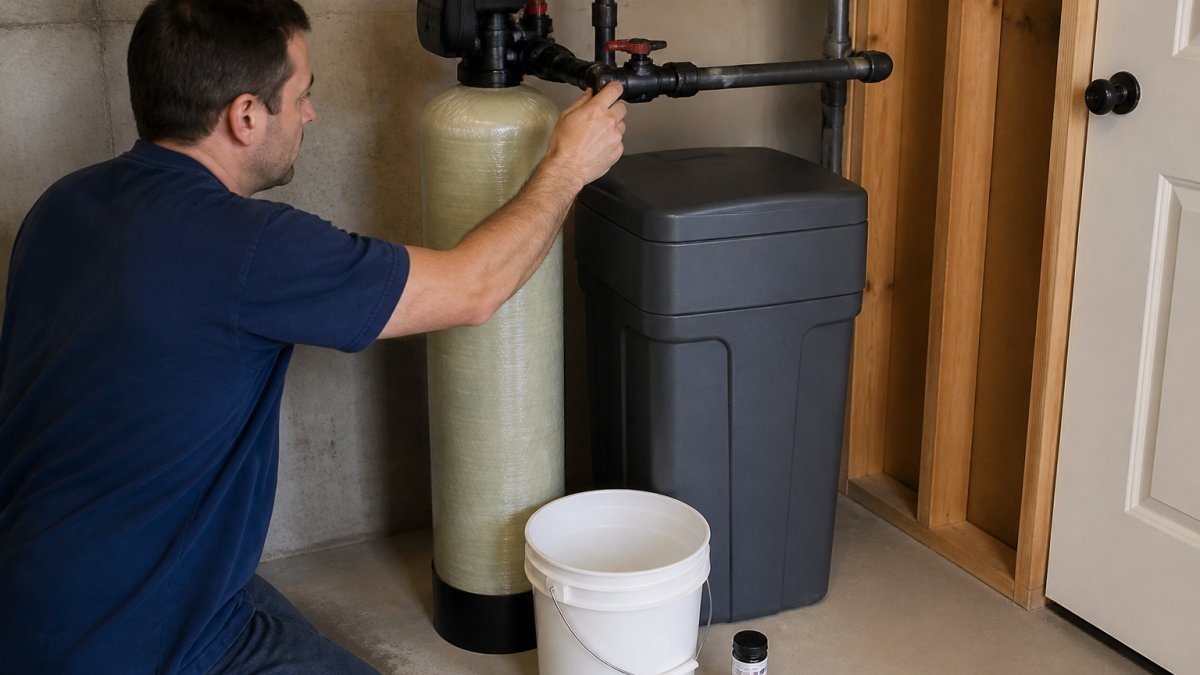
Here is the order we'd work in:
- Test first. You can't size a fix without a hardness number.
- Set a target. Aim for soft water at every faucet, not just the kitchen.
- Choose a treatment method. Softener, salt-free conditioner, or filter-and-softener combo.
- Install at the main line. Treat water where it enters the house, before the heater.
- Flush and clean on a schedule. Prevention handles the pipes; cleaning handles the fixtures.
- Recheck hardness twice a year. Adjust settings as your water changes.
Flush, Clean, and Maintain Fixtures on a Schedule
Fixtures need a schedule of their own. Scale still collects on aerators and showerheads even with treated water.
Soak showerheads and faucet aerators in white vinegar every one to three months. Rinse, scrub with an old toothbrush, and reinstall. Our step-by-step guide on how to remove limescale from showerheads covers the soak times and safety notes. Flush the water heater once a year to clear sediment from the tank bottom.
Water Softener for Limescale Prevention: What to Compare
A water softener for limescale prevention removes calcium and magnesium through ion exchange. That's the method with the strongest consensus behind it.
Most guides stop at "buy a softener." The useful comparison is harder: which softener, sized how, at what operating cost, and with what trade-offs. Here is how to compare systems on the points that actually change your results.
Size the unit to your hardness number and household
Capacity is rated in grains of hardness removed between regenerations. The working formula most installers use is:
Grains per day = hardness (grains per gallon) × daily water use (gallons) × people in the home
A common planning figure is 75-100 gallons per person per day. So a four-person home at 12 grains per gallon and 80 gallons per person lands near 3,840 grains per day. A unit that regenerates every seven days needs roughly 27,000 grains of capacity, plus a reserve. That is why testing first matters: a 24,000-grain unit is right for one household and undersized for the next.
- Capacity. Match grain capacity to your measured hardness, bathrooms, and household size, not to the label on the box.
- Salt and water use. High-efficiency models regenerate on demand and use less salt and water per regeneration than older timer-based units. Ask for the salt dose per regeneration and the gallons used during regeneration.
- Installation. Bypass assembly, drain line, and power access matter. A softener needs a drain for regeneration discharge and a grounded outlet.
Operating trade-offs to weigh before you buy
- Salt. You will buy and carry salt bags on a schedule. Budget for it as a recurring cost, not a one-time purchase.
- Water use. Regeneration uses water. High-efficiency units cut this, but it is never zero.
- Sodium in drinking water. Ion exchange adds a small amount of sodium. If sodium is a health concern, a reverse-osmosis drinking-water stage at the kitchen tap is the usual fix.
The Soft Water System is a dedicated softener that includes a water hardness test strip kit and is offered in models sized for 1-4, 4-6, and 6-8 bathrooms. The Lifeguard Filter & Softener pairs carbon filtration with softening for water that also carries chlorine and taste issues.


If you're weighing whether treatment is worth it long term, our article on whether water softening prevents limescale buildup explains what softening does and doesn't stop.
Natural Remedies vs Commercial Descalers: Pipe Safety First
Vinegar and lemon juice work on fixtures. They are a poor choice for long soaks inside pipes. That distinction is where most advice goes wrong, and it is the difference between removing scale you can reach and preventing scale you cannot.
Vinegar and lemon remove; they do not prevent
White vinegar, lemon juice, and citric acid dissolve calcium carbonate on surfaces you can rinse. Bicarbonate of soda adds a mild abrasive for scrubbing. None of these belong in a closed plumbing system for long soaks, because prolonged acid contact can attack metal fittings and seals.
More important: these remedies do not prevent limescale inside a plumbing system. They clean what you can reach, aerators, showerheads, faucet spouts, kettle elements, and exposed fittings.
Pipe-material and appliance safety
Acids and descalers interact differently with different materials. Before any soak or flush, know what you are treating:
- Copper and brass. Short, diluted vinegar contact on a removable aerator is generally fine. Long soaks can dull and pit the surface.
- Chrome and plated finishes. Acid can strip or cloud plating. Keep soaks short and rinse thoroughly.
- Stainless steel. Generally tolerant of mild acids, but chloride-containing cleaners can cause pitting over time.
Using commercial descalers safely
Commercial limescale removers are formulated for plumbing. Read the label and confirm it's rated for your pipe material and fixtures. Never mix cleaners, mixing an acid with a chlorine-based product can release dangerous gas. Never leave a descaler sitting in the lines longer than the label allows, and flush thoroughly with water afterward.
One more caution from Tap Score on scale and corrosion: not all pipe scale is harmful. Some insoluble oxidation scale actually shields pipes from further corrosion. That's a different problem from limescale, and treating every deposit as scale can do more harm than good.
When Limescale Buildup Means a Real Blockage
A real blockage announces itself. Reduced flow at every fixture, not just one, points to the main line. A single slow faucet usually means a clogged aerator.
Call a plumber when you see:
- Water pressure drops across the whole house
- Discolored or gritty water at multiple taps
- Banging or popping from pipes or the water heater
Scale-related damage rarely fixes itself. A plumber can inspect the line and help you determine whether you're looking at mineral deposits, corrosion, or a failing valve. Fixing the cause prevents the blockage from returning.
Build a Long-Term Maintenance Schedule for Hard-Water Homes
Hard-water homes need a calendar, not willpower. Put these on it and the rest takes care of itself.
| Task | Frequency | Why It Matters |
|---|---|---|
| Test water hardness | Every 6 months | Confirms treatment is working |
| Add salt to softener | Every 4-8 weeks | Keeps resin regenerating |
| Soak showerheads and aerators | Every 1-3 months | Clears fixture scale |
| Flush the water heater | Once a year | Removes tank sediment |
| Inspect exposed pipes | Once a year | Catches scale early |
| Service the softener valve | Per manual | Prevents hard-water bypass |
If you're weighing whether treatment is worth it long term, our article on whether water softening prevents limescale buildup explains what softening does and doesn't stop.
Frequently Asked Questions
Is vinegar effective against limescale inside pipes?
White vinegar and citric acid dissolve calcium carbonate on fixtures, showerheads, and faucet aerators well, but they are far less reliable inside pipes. You cannot keep vinegar in contact with a long horizontal run of pipe, and repeated strong acid soaks can wear on older metal fittings. Use vinegar for removable parts and visible scale, and treat the water itself to prevent limescale from forming in the first place.
Can a water softener prevent limescale in pipes?
Yes. An ion-exchange softener removes the calcium and magnesium that form calcium carbonate, so the water entering your pipes no longer deposits scale. That is different from a salt-free conditioner, which alters how minerals behave rather than removing them. If your goal is to prevent limescale buildup in pipes over the long term, softening is the more direct fix, and sizing the unit to your bathrooms and flow rate matters as much as the type.
How can you tell if hard water is affecting your plumbing?
Watch for white crust on faucets and showerheads, cloudy glassware, soap that will not lather, and reduced flow from aerators. Stiff laundry and film on skin are common too. A hardness test strip confirms the number behind those signs. If you see pressure dropping at multiple fixtures at once, scale may already be narrowing the pipe interior rather than just coating the surface.
Does all pipe scale need to be removed?
No. Oxidation scale, the dark coating that forms on some metal pipes, can actually protect the pipe from further corrosion, so it is not the same problem as limescale. Limescale is the pale, chalky deposit from hard water, and that is the one worth preventing and descaling. Treating every kind of pipe scale as identical can lead to unnecessary or even harmful cleaning.
Limescale is a slow problem that rewards early action. The Water Softener Company builds high-efficiency systems for city and well water, with salt-free and softening options, free shipping to the contiguous 48 states, and components made in the USA. Get started with The Water Softener Company and protect your pipes, water heater, and appliances before the scale wins.
